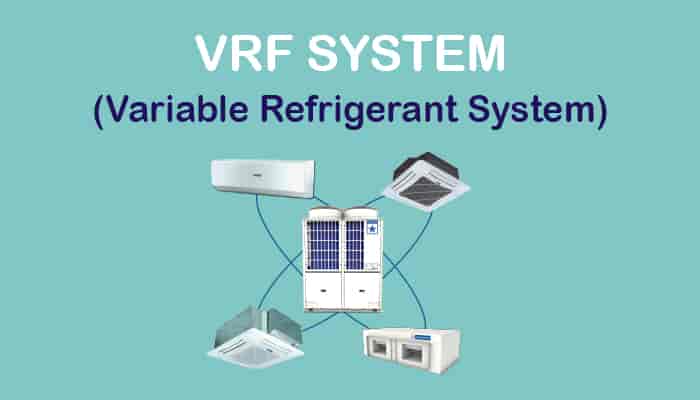
How does VRF System Works ?


A VRF system (Variable Refrigerant Flow) is a type of advanced HVAC (Heating, Ventilation, and Air Conditioning) system that provides efficient and flexible climate control for commercial and residential buildings. Here's a breakdown of how it works:


🔧 Basic Concept

VRF systems use refrigerant as the cooling and heating medium, which is conditioned by one or more outdoor condensing units and circulated within the building to multiple indoor units.


⚙️ Key Components

  1. Outdoor Unit (Condenser)

    • Contains the compressor(s) that vary the refrigerant flow.

    • Connected to multiple indoor units via refrigerant piping.

  2. Indoor Units (Evaporators)

    • Come in various types: wall-mounted, ceiling cassette, ducted, etc.

    • Can be independently controlled for individual zones.

  3. Refrigerant Piping Network

    • Copper pipes carry refrigerant between the outdoor and indoor units.

    • Often a 2-pipe or 3-pipe configuration (depending on the system type).

  4. Control System

    • Centralized or individual controllers manage temperature, fan speed, and mode for each zone.


🔄 How It Works

1. Cooling Mode

  • The compressor pumps refrigerant to indoor units.

  • The indoor units absorb heat from rooms and send the heat-laden refrigerant back to the outdoor unit.

  • The outdoor unit releases the heat to the atmosphere.

2. Heating Mode

  • The cycle reverses using a reversing valve.

  • Indoor units act as condensers and provide heat to the room.

  • Outdoor unit absorbs heat from the outside air (even in cold conditions).


🔁 Variable Refrigerant Flow

  • The compressor modulates its speed (inverter technology), adjusting refrigerant flow based on demand.

  • Only the needed amount of refrigerant is sent to each indoor unit, which improves energy efficiency.


🌀 Types of VRF Systems

  1. Heat Pump VRF

    • All indoor units operate in either heating or cooling mode at one time.

  2. Heat Recovery VRF

    • Allows simultaneous heating and cooling in different zones.

    • Uses a 3-pipe system and branch selector boxes to route refrigerant efficiently.


Advantages

  • High energy efficiency (especially with inverter compressors)

  • Individual zone control

  • Quiet operation

  • Flexible design (good for retrofits and complex layouts)

  • Heat recovery options


Disadvantages

  • Higher initial cost

  • More complex installation and servicing

  • Requires trained technicians for maintenance


Comments

Popular posts from this blog

Commonly Used ASTM Materials in Process and Power Plants

Commonly Used ASTM Materials in Process and Power Plants : CARBON STEEL STAINLESS STEEL LOW ALLOY STEEL LOW TEMP. CARBON STEEL FORGINGS A105 A182 Gr F 304 1 Cr 1/2 Moly A 182 Gr F12 A350 Gr LF-2 A182 Gr F 316 1 -1/4 Cr 1/2 Moly A182 Gr F11 A182 Gr F 321 5Cr 1/2 Moly A182 Gr F5 A182 Gr F 347 9Cr 1 Moly A182 Gr F9 CASTINGS A216 Gr WCB A351 Gr CF8 (SS 304) 1 1/4 Cr 1/2 Moly A217 Gr WC6 A352 Gr LCB A351 Gr CF8 M(SS 316) 5 Cr 1/2 Moly A217 Gr C-5 A351 Gr CF8 C(SS 321) 9 Cr 1 Moly A217 Gr C-12 A351 Gr CF8 T(SS 347) PIPE A53 Gr B(WELDED/SEAMLESS) A312 Gr TP 304 (WELDED &SEAMLESS) 1 Cr 1/2 Moly A335 Gr P-12 A333 Gr-6 A106 Gr B(SEAMLESS ALWAYS) A312 Gr TP 316 (WELDED &SEAMLESS) 1-1/2 Cr 1/2 Moly A 335 Gr P-11 A671 API 5L Gr B (LINED PIPING) A312 Gr TP 321 (WELDED &SEAMLESS) 5Cr 1/2 Moly A335 Gr-P5 A672(ONLY FOR LARGE BORE) A312 Gr TP 347 (WELDED &SEAMLESS) 9Cr 1 Moly A335 Gr-P9 A409 1-1/4 Cr 1/2 Moly A691(ONLY WELDED) A358 Gr 304/316/321/347 (Class 1...

Types of Loads Considered for Piping Stress Analysis

Piping Stress Analysis is the practice and discipline carried out behind the scenes of any piping design project to ensure structural and operational integrity, and optimal design. All piping systems are inevitably subjected to various kinds of loads in their design life cycle. These loads develop stresses in the arrangement. Pipe stress engineers typically analyze such systems for stress using reliable software such as Caesar II to check that the stress levels are within the permissible limits as defined by the codes/standards.  The following are some of the most common type of loads considered during stress analysis:- Wind Load: The majority of all piping system installations are indoors where the effects of wind loading can be neglected. However, there are sufficient numbers of outdoor piping installations where wind loading can be a significant design factor. Wind load, like dead weight, is a uniformly distributed load that acts along the entire length, or ...

What is Piping Engineering and Its Scope in Mechanical Industries ?

Before we Learn about What is Piping Engineering and scope of Piping Engineering In Mechanical Based Industries . First lets Know about What is Pipe and Piping Process ? When a fluid is required to be transferred from one location to other, pipe is required. A pipe is considered as a pressure tight cylinder which is used to convey fluids under pressure through materials of commercially available designation. What is a Pipe ? A pipe is a tubular section or hollow cylinder, usually but not necessarily of circular cross-section, used mainly to convey substances which can flow — liquids and gases (fluids), slurries, powders, masses of small solids. It can also be used for structural applications; hollow pipe is far stronger per unit weight than solid members. Piping systems act like a nervous system for the flow of fluid in the huge network of any industry around the globe. What is Piping ? Piping is an assembly of pipe, pipe fittings, valves, instruments and speci...